 Premium
Natural Sciences
Diversity and identity strengthen health
37 minLecture
A keynote by Florianne Koechlin | Translation · EN
Woven & Entangled
A keynote by Florianne Koechlin, held on October 13, 2024, as part of the Autumn Conference of the Natural Science Section at the Goetheanum.
A fantastic variety of tiny organisms pulsate in the soil. They enable plants, animals and humans to survive. Microbes were already on earth a few billion years before other life developed. They "invented" almost everything that makes up life. They are interwoven with us in the most complex way, and cooperation and competition are often indistinguishable, a network of relationships that is constantly changing. Communication and networking – that is also what makes up every living being, be it a bacterium, an ant or an oak tree. What does this mean for our food and for agriculture? I asked numerous experts and always got the same answer: diversity, soil health and local cycles are the recipe for tomorrow.
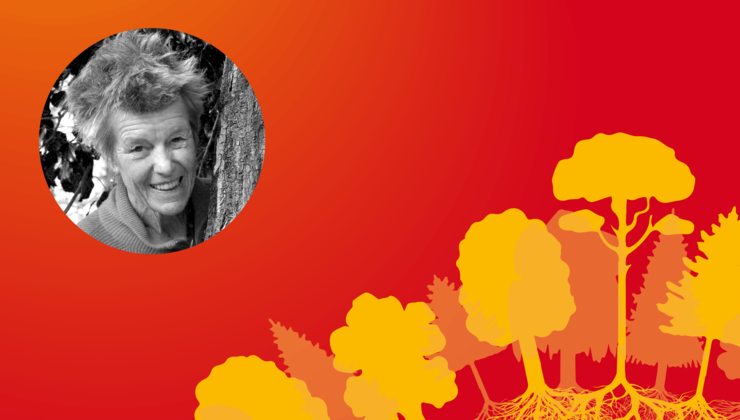
Florianne Koechlin, 1948, studied biology and chemistry; she became known as a critic of genetic technology and author of various books and numerous articles. She is the managing director of the Blauen Institute (www.blauen-institut.ch). Her latest book verwoben & verflochten. Was Mikroben, Tiere und Pflanzen eint und wie sie uns ernähren was published in 2024. She is also engaged in painting (www.floriannekoechlin.ch).