
Молодёжь
Мужественное мышление Бергсона
14 минРазговор
Автоматическое распознавание речи (ИИ), ещё не обработано и не отредактировано — возможны ошибки. Как создаются эти тексты
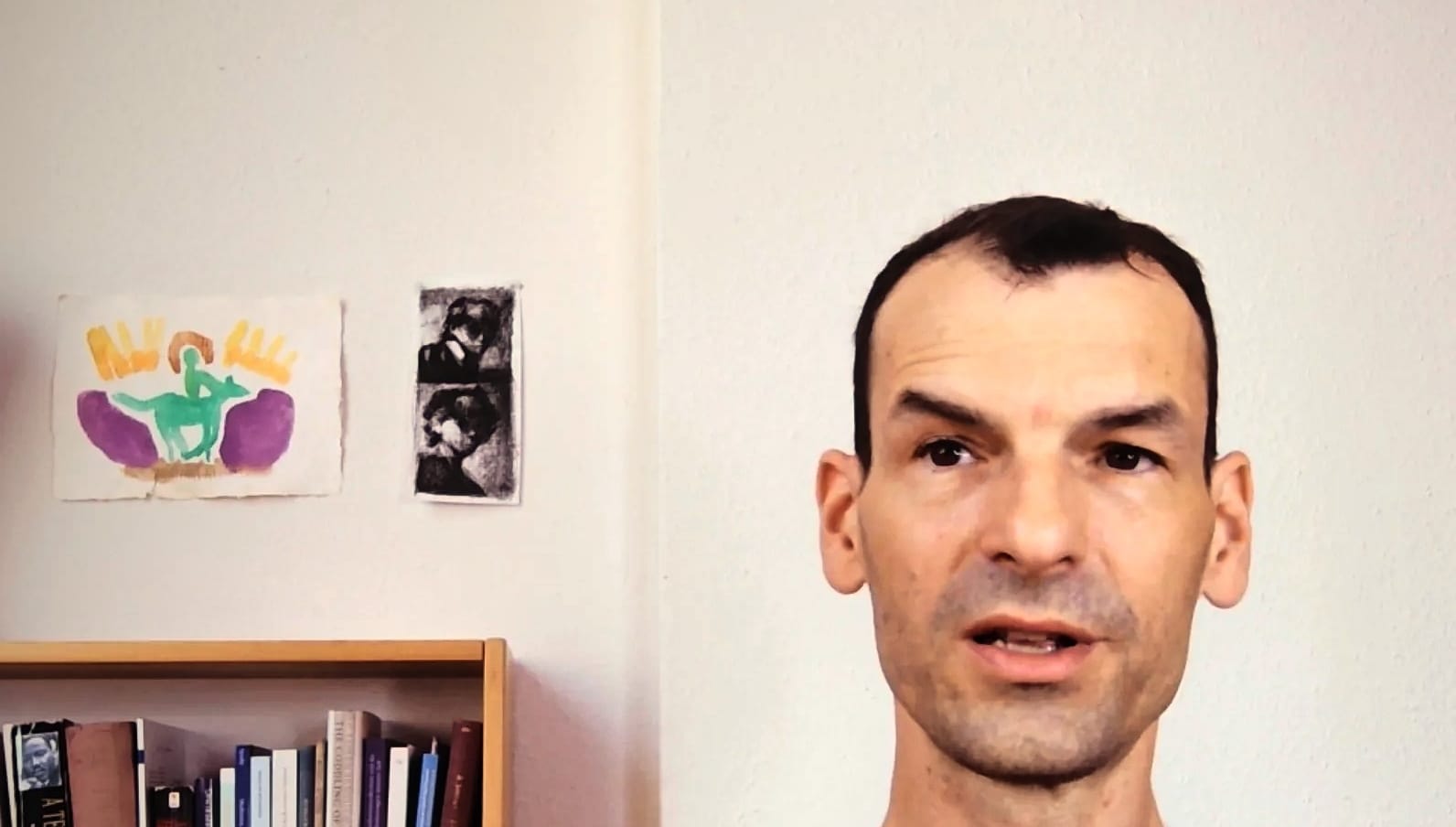
[music] This is Questions of Courage, a podcast from the youth section at the Gertiana, hosted by Nathaniel Williams. Welcome to Questions of Courage. If you consider joining an emergency response group, it could be for fire, emergencies, it could be for medical emergencies, or responding in conflict areas, even war. One of the things that mature responders will advise you is be careful of tunnel vision. You come into an emergency situation and you see people who are hurt and you want to help them. You can feel fear and adrenaline and it's easy to make the problem worse if you act without thinking. And you know what's true on a small microcosm emergency scale is in some way also true on a macro scale. Today we live in a moment where there's emergencies that are of different types . We have wars driven by really extreme nationalism coming promoted through the United States, but also Israel at the moment very strongly, and Russia, and we have of course strong nationalism in Ukraine as a response.
And it's just to name a few when we take a look at this situation, or let's say the ecological and climate emergencies that so many people are currently already struggling to face, but also will have to struggle to face more in the future without a doubt. It's natural that we want to be of help, especially young people, they want to help, but they can sometimes feel like I don't, how can I do something that's really fruitful or helpful? And one of the things that we can ask is can we get a little perspective? And you know with the United States where we see right now in the United States , we can't avoid recognizing that it's currently a source of a lot of suffering and chaos for people around the world. There's a lot of corruption, particularly coming from the executive branch, but in some ways from other all parts of the government. And it's the 250th year of the Declaration of Independence. In the United States, the Constitution formed after the Declaration of Independence. But 250 years ago, this group of colonists, some of whom had already been living freely for some time, declared their independence together from the British Empire. And a long history has unfolded a remarkable history that deserves unspeakable consideration and respect, and despite the dark moment that we're in right now with the United States.
And the history of the conversation around the United States is not over. And one thing we can do is we can ask what could the United States offer the future, the ideas at the root of the United States, the culture. And I say that and don't suggest that the United States will be able to deliver even. I mean maybe the United States no longer exists, we can't recognize it, there's other states in North America, there's a civil war. We don't know what can happen. When we look at history, we can see processes like this, the Republic of Rome that developed into the rule of Caesars. You know, eventually it's not recognizable anymore as a republic, but the ideas of the Constitution, of the Romans, inspired in some measure, the Americans to form the United States. And in the future we can think maybe there's going to be people who look back on the United States and they say there is something that we can work with for the future. And you know the United States Constitution, it has inspired countless or many modern states, I'm sitting in Switzerland. They formed their new constitution in 1848 following the model and some measure of the United States.
What would that be like now when we look in the future? What could promising elements of this ongoing conversation of statecraft, of living together? What could be in the future? And I'd like to offer a few reflections on this, not just in this episode, but a couple more. And in this one I would just like to reflect on the idea of civil society and what this could mean for thinking about states in the future. And indeed already in some measure can be seen. But first of all when we look at the United States Constitution, it's membered into three parts. We have the executive, the legislative, and the judiciary. And there's a lot, the most important things, are not in the Constitution. In fact, the Bill of Rights, which was added later, limits the state so that there can be other ways of living, not just political ways of living. And I'd like to talk about a threefold way of thinking that emerged in the centuries, the last two and a half centuries in North America and in some ways around the world.
That is not the threefold constitution, but instead a way of thinking about the state and you think about the market and you think about what I'm going to call civil society. And the term civil society, we find it in John Locke, it's the source of legitimacy, but I'm not going to talk about the philosophical nuances of that theory. But instead, I just want to focus in this episode on civil society in a particular way. And I don't want to talk about the market, which also exists outside the state, but civil society in a particular way. And some people talk about it like the volunteer sector. We could talk about it as the place where we are able to follow our individual inclinations voluntarily, where we are not coerced, we're not forced to do anything. And where there's a broad degree of freedom. And all those things can be said about capitalism in a certain way. I'm going to come back to that in another episode. I just want to talk about the question of nationalism, of spirituality and religion, of education in the history of the United States, and how they could inspire ways of thinking where we see civil society in a new way.
And James Madison, who is a big part of the founding of the Constitution, is an important figure in this conversation. He suggested that a society where there 's religious tolerance or freedom had a more tolerant population. And Thomas Jefferson, who was the author of the Declaration of Independence, I think the piece of legislation he was most proud of, was the separation of church from state, where the church would be totally cut off from revenue from the state. And we have, in Madison and Jefferson, two parts of the religious and the spiritual question of civil society, the idea that you would not make laws that force people to believe things. So you have very free laws, freedom of speech, of faith, of congregation and assembly, Madison. And then on the other hand, Jefferson saying the no church should receive legitimacy through the state by receiving money. No tax money should go to the churches. Jefferson's reasoning, which I've commented on in different places, was when we are forced to live our spiritual lives out of enthusiasm and out of the spirit, then people will support it because they believe that it's valuable, that they voluntarily acknowledge its value, and they'll give to support it, they'll give resources, they'll volunteer, they'll help build it up.
And then you kind of have a level, a kind of competition of who can be, who can inspire, so to say. And that in the end, you'll have a more healthy spiritual religious life if you have this kind of separation. Now, this argument, of course, wasn't only for religion and the churches, but it was also something for the schools. We know it from Wilhelm von Humboldt, but also John Stuart Mill, who wrote in England, the English philosopher on liberty. And the idea was that schools should be separated from the state in a similar spirit, that if we have schools really rooted in civil society or the voluntary sector, then you don't have a kind of schools that have an advantage through their state association. And if we follow Thomas Jefferson's thinking, any school that receives support from the state is guaranteed the income, because if you don't pay your taxes, you can go to jail, so they can just give your money to these schools. And these schools can be very bad. And in the meantime, you give this advantage to these schools that have bad conditions to succeed through inspiration. So it's a kind of corruption of the school system. The third perspective is nationalism.
And right now, the United States is suffering from a kind of fever of nationalism, white nationalism, European nationalism, of a very dark variety, particularly in the military. We see it at the moment, the military leadership. And one of the things that we see in the Constitution, though, was that there was not a particular religion, but there was not also a particular nation. Now, this is complicated, of course, because you had a slave market, you had the enslavement of mostly almost entirely Africans. But still, the framers were aware of that, and they fought to not have the word slave and not to have ethnic language in the constitutional document. And Thomas Jefferson, who wrote the first draft of the Declaration of Independence, you can find this in his autobiography, compared the enslavement of the Africans to the treatment of the colonists. So there was an awareness, it's a very beautiful passage, and Thomas Jefferson was a slave owner, as well known. Of course, his whole family relationship also with enslaved peoples has been under extreme scrutiny. But he demonstrates that he could think about how the Africans themselves were just the plight of the Africans, the enslaved Africans, was just another example of English tyranny.
So the framers of the Constitution were thinking beyond race. They were thinking beyond nation when they were writing this. They were able to do that. You look at the first draft of the Declaration of Independence and you can see it. And so you have them creating this state that relinquishes education, that relinquishes religion, that relinquishes nationhood, and offers within that framework, the creation of laws, and that also offers the protection of individual liberties. What then do we find? We have what's called the third sector in English, Anglo- sphere political theory, developing over 200 years. One of the cornerstone books on this political theory is Alex de Tocqueville's Democracy in America, where he highlights the importance of the cultural associations, the schools, the libraries, the reading groups, and how there was this whole cultural life that was totally voluntary and unregulated. This was also, of course, the incubator for the civil rights movement, for also the abolitionist movement before that within civil society and this free sphere . That's where there was this cultural spiritual dialogue that was free to happen and was not financed or controlled by the state.
Civil society, the third sector of volunteerism and philanthropy. Now, when we talk about philanthropy, a lot of people think about charity. They think about alleviating economic woes, like poverty, hunger, especially in Europe, people think along these lines because it's a place where there's a very strong welfare state in many countries. But in the United States, philanthropy is way bigger. It has been over the last 250 years. It has to do with groups of people investing capital towards bigger aims. Like, if you think philanthropy is about charity, think about John Hopkins University or Harvard. Those aren't exactly what you think about charity, but actually the colleges that were not state-funded were created through people gathering money and creating cultural institutions. And this kind of separating the state from religion and spirituality, from the nation and also from education, this is something that we have not perhaps learned enough from. And when we see the nation state movement, which is 100 years old, and we see a state like Israel, or we see what's happening in the United States right now with this extreme America first, but a certain part of America, this hate towards immigrants who are not European descendants that is being fostered, we can see that the separation of nation and state in the United States is suffering an extreme setback at the moment.
But we can also sense this ideal of a state that is not aligned with a certain nation, but instead protects many nations that is separated from all nations, even though there might be national languages. We can see a state that separated from religions are fostering certain religions and protects religions generally. And this places where there could be schools, not only colleges and universities, but we might even imagine the elementary schools, middle schools and high schools, all ages where different types of education and experimentation are supported. And people try to succeed in creating widespread democratic education, so accessible education for everyone without sacrificing independence. One of the lessons that I think can be learned from the history of the United States, and even the present moment, is a separation of a kind of cultural life and civil society from the state in a way that's not just the same as the market. That's based more on giving than exchange and transactions on mutual enthusiasm and deals and contracts. This is certainly deeply connected with something that Rudolph Steiner promoted over 100 years ago with his idea of independent spiritual and cultural life.
Though he did it in the European context, and today in the year of 250 years since the Declaration of Independence, we can consider how in the future there may be states, maybe the United States will align more with its better angels or other states, drawing on some of these visions will work with them in the future. And I would like to offer two more short reflections on the United States in this year and other episodes, but for today, I just wanted to focus on this aspect. The go-to-honum itself where the youth section has a kind of headquarters, of course, while we're connected with volunteers, young people all over the world, is one example of a free cultural initiative. The buildings here have been worked on and in some measure even constructed by volunteers as well as professionals, and all united by an interest in expanding knowledge towards the spiritual of the human being in the world. And if you are hearing this and you would like to make a donation to support this work, I could just say that it is very much appreciated and also needed. Thank you.
Водкаст с Nathaniel Williams
250 лет назад группа колоний в Америке объявила о своей независимости от Британской империи и впоследствии создала демократическую республику США. Это первый из трёх эпизодов. Он посвящён понятию гражданского общества и представляет идеалы, которые и в будущем могли бы положительно влиять на конституции.
Литература:
Thomas Jefferson (1944) The Life and Selected Writings of Thomas Jefferson: Including the Autobiography, The Declaration of Independence & His Public and Private Letters. (Random House Publishing Group).
Kathleen D. McCarthy (2011) American Creed: Philanthropy and the Rise of Civil Society, 1700-1865. (University of Chicago Press).
Alexis de Tocqueville (2010) Democracy in America: Historical-critical Edition. (Liberty Fund).
Английский | Субтитры · DE · EN
Публикация: 9 октября 2026 г.
Переведено ИИ с оригинала (Deutsch), не отредактировано · Читать оригинал