Social Sciences
Everything Given Away and Much More Gained!
52 minConversation
Translated by AI from the original (German), not reviewed. How these texts are made
Martin von MackensenIt is so geared to mass formation that I really have to kill the plant artificially so that it then, somehow, four weeks later, is at the bar [unclear]. That is our standard today; one just has to explain really clearly what is actually happening today in conventional agriculture—it is not about the people. I have complete understanding for my conventional colleagues, in whatever production [unclear], in what situations they are. That is not what it is about at all,
I don’t want to attack the conventional colleague at all, but I want to attack the system and simply say: this system is leading us into the abyss, or—we are already right in the middle of it. We must radically question the whole system and develop and research the building blocks of a reasonable, future-viable agriculture. Of course we have much knowledge, only in rudimentary form, and we urgently need more research. That is a huge topic.
InterviewerHow do we want to shape the world? They are our hands; the future that is laid depends on us, and in this series I speak with people who move the world, who change the world—with people of whom I have the impression that they make a truly decisive contribution to a better future.
Today with Martin, Martin von Mackensen. Martin is a wonderful human being. Martin is a farmer, grew up at Tottenfelderhof. I will ask you in a moment whether you can tell us a little about Tottenfelderhof. Today you are also the leader of this farm. Part of the leadership. Being part of the leadership is already very important. And then at the same time you teach at the ordinary School, but also at the agricultural school there. Worldwide it is the only one that has so far been recognised, where one can really learn biodynamic agriculture in the proper sense of the word. And you are on the road a lot, teach, give courses and so on. Martin,
InterviewerMy first question to you: was it always clear for you with agriculture?
Martin von MackensenNot at all, not at all. How did you—? When did you discover your calling, and how did that happen? There are actually two strands. One strand is: as a child from an academic household, I was in the high meadows during the holidays, about 1,000 metres, the last agricultural zone below the forest. Making hay, meadows, because there one can only do livestock farming, and the smell of this hay—I still have it today. That is something that touches me so deeply inside, livestock farming and making feed, making hay, making fresh feed, with the scythe on the steep slope as a six- or eight-year-old: that is what I want to do in the future. And of course that got lost.
And then at 16 I did another voluntary work assignment in Finland, three weeks during the holidays. And then I was... That was Waldorf school. That was Waldorf school, class. And then I was—I had the great good fortune, through someone who pointed me to it, to meet Joseph Beuys, and that led directly to the tree-planting action 7,000 Oaks. And I really took part in many planting actions, always in spring and autumn, and through that had an intensive relationship with Joseph Beuys, and it was Beuys who, on a four-lane road, on the central reservation, while crossing the road, when I then said: “Yes, I have now finished school, have even trained as a machine fitter, and now I want to study with you, and I can do something when it comes to metal.” And he had said: ‘You do have something to do with agriculture, that is much more important.’ So I was basically turned away and he said: ‘That is much more important’; four months later he was dead. He had actually seen that. And for me that was then definitively the point at which I said: good, then I want to try it with agriculture, and then I did an agricultural apprenticeship. After the apprenticeship I immediately slid into an offer of farm management and did farm management for some years, was responsible for a dairy herd that was very highly bred. So to speak, I experienced myself how this path is a dead end, our present-day livestock keeping, our present-day livestock breeding. Yes, and then I came up to Lürkenfeld; by then I was already 20.
Okay. Let me ask: Joseph Beuys—I had, well, that connects us. I also had an intensive relationship with him, certainly not as intensive as yours, but for example I also had the experience of taking a walk with him, and then just how directly he lives with the plants, with the animals—that was incredible, how deeply connected, and at the same time this incredible—how should one put it—this incredible spiritual potency of this human being, who basically turned the concept of art from its head onto its feet and actually made clear what we are also doing here, namely we want to shape the world; this social shaping is today the task of every human being. My question to you: how did you get to know him, and how was this encounter? {Martin von Mackensen} Yes, it was very bizarre, as very often with Joseph Beuys. Through that I had—it was still the Iron Curtain, in ’81, I was 15, and an uncle of mine was an artist in the GDR, metal designer, art blacksmith, Association of Fine Artists, without being a party member, and he was interested in Beuys; he had no substantial material, he had been able to read a little something at the art academy in Dresden—if you could somehow see him as a human being sometime and describe to me, what kind of person he is, that would interest me. Three weeks later or six weeks later I walk past the Edeka and he is hanging a poster on the door: a seminar on school policy with Joseph Beuys. Then it came back to me: I’m supposed to get to know who this is. Didn’t I go there? That was the Greens, and that was the Greens in Kassel, and it was a completely smoke-filled workshop [unclear], and there they were discussing with a Berlin sociologist what a green school policy could actually be like, and who was not there was Beuys, and I sat there for an hour, already an hour and a half, I of course understood very little of this discussion, and suddenly Beuys came and I became attentive, and then it was already the break, and they all went into a tavern, because it was supposed to continue somehow an hour and a half or two hours later, and they wanted to take me along, and I keep looking the whole time at what Beuys is doing; Beuys stayed there, “Listen, no, no, I’m staying here too,” and bang, at that age I was alone with Beuys for an hour and a half, because the appointment he had there, for which he had stayed, did not come. That’s how it was, that’s how it came about. Yes, of course that was a very important appointment, because that was Kibi Hübos, Karl Heinz Hübos, he was professor of garden and landscape planning, and with him he had—that was the only one who already knew what his contribution for the coming documenta should be, and he wanted to discuss this professionally, and then he also came at some point, and Beuys also takes over—Martin can stay here and... Martin can stay here, and then at the end he said to me, you can then do something with it and so on so of course that happened too, and I knew that evening: my life is now a different one. What convinced me so much was what this person achieved with me, how much humour, how much interest, how much exchange he managed with this 15-year-old lad there; that won me over, and then I experienced a great deal with Beuys, very many, very bizarre situations also outside Kassel, in exhibitions, in installations, in one in Bonn, in a comprehensive school for direct democracy, a congress, and so many, many bizarre situations and beautiful situations that shaped me very much.
And today the big cities are to some extent dying the climate and heat death, and the whole of society is dying the bureaucracy death, and at that time Beuys, with your collaboration, actually began a programme instead of administration, which was meant to continue, and which would play an even greater role today. But that means it was, so to speak, this broad view—you are not—it was not always clear that you didn’t have it at all. Actually this view of society, how can one change society, and then Barbe [unclear],
Interviewerthen it was basically Joseph Beuys who suggested this place to you: agriculture. {Martin von Mackensen} Yes, yes, absolutely, absolutely, absolutely, agriculture is a huge revolutionary force if one does it differently. Because in agriculture there is healing, and Paracelsus is completely right when he says: yes, just make your food into a medicine—and today I would modify that and say: just make your relationship to the field from which you live into your medicine.
And agriculture is at the same time the chance for the climate rupture—I don’t say climate change, but I say climate rupture, because I really consider it a rupture now. And we can essentially only make a substantial contribution with agriculture in the next 100, 200 years, and that is what we research; that is a central question for me—namely, how can agriculture today become such that it—what we as humanity have done. Over the last 150 years or so, we have simply blown about a third of this earth’s fossil raw materials into the air in terms of CO2. And we can, with the help of plants, of forests, in the climate zones where that is possible. We can bind carbon and thereby make soils more fertile, make soils more resilient, make soils more suitable for the difficult situation that is coming—a central question of agriculture—and we still think in societal terms, yes, that could also be a topic, perhaps for a little bit too—no, it is the central topic of agriculture, because where should we—how are we now supposed to press CO2 into the seas, under the seas or something; those are all crazy things, they will not solve anything for us at all. {Interviewer} Let me ask again, we will come to that, but I would like to return to something: is it that—so when we become aware of what enormous significance agriculture has at all for this planet, how should one say, remaining in balance, for the seasons being right and so on, if that becomes more conscious—how is the order—[it] lies in the fact that agriculture has de facto become one of the most massive destroyers today, and what is the reason, Martin, that when one wants to change something about it, the farmers are the first to take to the streets and fully defend this wrong path, an agriculture that is increasingly ruining the world. {Martin von Mackensen} Well, the decisive point for me lies of course in the history of agriculture, namely that of the last 150 years. Around the switch that happened in the 19th century, then into the 20th century, nitrogen, mineral nitrogen appeared, and that is of course very exciting, the Haber-Bosch process, a genuinely German topic, a fruitfully dramatic and also tragic little chapter of German history. The Haber-Bosch process was made industrialisable at an incredible speed during the First World War, and then one discovers, actually in 19, 20, 21. We have these plants, and we can no longer produce this nitrogen for the explosives and weapons industry, because—well, treaty, lost, lost First World War and so on—and now, what can we do with this nitrogen? Ah, agriculture, and that has to be studied, the plants, as previously the Schramlele [unclear]. Exactly, one has to study that closely, one has to—that is, so to speak, actually, every child today should have to learn this at school: what does nitrogen do to plants, to soils, to the climate and so on, to water. What does the—say it again, I believe it is completely important to make this really clear to oneself: nitrogen acts through water, through soil water; it does not act through this process that actively does something in the soil into the root, rather the plant takes it up with the water. Nitrogen is normally super, super scarce. Evolution is, so to speak, oriented towards the fact that in life one always has to handle nitrogen sparingly, that it is always a scarce good that one must always incorporate quickly, that is always quickly transformed. And now one brings this overloaded mineral, plant-available nitrogen into this plant-soil life, as Steiner characterised it incredibly well, and that drives the plant extremely, and it becomes susceptible, susceptible to all kinds of insects, because the skin becomes thinner, the inner substance becomes more watery and larger. It drives the plant into the plant. Doublings, doublings—it wants to become ever larger, but the formative forces recede, of course. And it is not only the insects, it is the fungi, all kinds of harmful fungi. The plants become so tall that they fall over. Now I have to develop a plant hormone that makes them shorter, and not least: I don’t fertilise the weeds. With that we have all four important criteria that lead to developing herbicides, developing insecticides, developing fungicides, and spraying the plants shorter and breeding them shorter. That is the modern path of agriculture. And now it continues: now one can smash agriculture apart, can say, okay, here one can do plant production, and there it is somewhat worse, do the entire animal production, production, and thereby the path a generation later is clear: agriculture is a commercial purpose for the purpose of earning money. And we have had that now for 100 years in our heads, in our hands, in the tractors, on the land, and that the forms in which we stand. We do have to see this path. Yes, it is of course—that all this is crazy, because of course they have long since adapted themselves, this whole way of being. They are supposed to be that, after all. But that is not from them; he thought they are the last little wheel in this system. That is already very, very dramatic, what has actually happened there. And we really must understand it in order to change it. Otherwise it always remains, otherwise we only ever scratch the surface and correct a little bit here and there and a little groundwater protection and a little climate protection and so on; none of that helps at all, rather we really must go back and say: what is agriculture actually, and what—how do we want to change. Otherwise it always remains, otherwise we only ever scratch the surface and correct a little bit here and there and a little groundwater protection and a little climate protection and so on; none of that helps at all, rather we really must go back and say: what is agriculture actually? and what, how do we actually want agriculture? What is agriculture actually? Yes, it is multifunctional; the scientists who deal with it in the critical agricultural report also say that have engaged with it—it is responsible for healing, it is responsible for education. If we said all that today—well, we have schools, we have hospitals, what is that supposed to have to do with agriculture? No, we know very well: the illness situation depends massively on nutrition. Proper nutrition with proper products is prevention with regard to the healthcare system. We know very well that our alienation of children from life processes is dramatic. Reading and writing—that is much, much less important than really having contact with the world out there and above all with myself in relation to my ability to act. And one can do that wonderfully with children in agriculture; it is the school place par excellence. We must so to speak, long since begin to think school and agriculture together much more intensively than just some kind of nice little horticulture lesson, where one is then also at an age when one is actually unteachable anyway, then one is brought into horticulture and then we say “Hey” and so “No, one has to develop that much earlier and much more intensively and much more generally.” That is also a theme of our conference here. So how do we get future children and young people to become what they can actually do, what lives in them; they must be able to discover that by doing it. And that is of course incomparably much more important again in times in which many, many children have no relationship at all. Only tweet away, but perceive the world only through a screen and pixels there—that means not having the experience of what it means to be able to act? What an animal is really like, how do stones feel, how do I climb a tree, what—how do I make fire, how do I put it out again? Yes, and how do I catch the sheep that have now run off, and so on, right? There are indeed many funny, fun, sporty, many, many fully human situations that agriculture offers, and we must lift them up, we must say, yes, that is an important factor, we must not forget it. And agriculturally, Agriculture is actually – that was just our actual question a moment ago: what is agriculture, then, actually? Agriculture is the chance to make this planet habitable for the future. Nothing less. We set out with biodynamics in order to keep this planet habitable and to make it ever better. So for me, for every farm, for every biodynamic farm, the decisive question is: How will it be in 30 years, when you hand it over? That we produce food, that we emit fewer climate-damaging gases, that we conserve groundwater and that we do nature conservation and so on – that is all very well and good, all important. But the decisive thing is the increase of soil fertility as the chance that human beings can continue to live on the earth at all. We cannot say, after all, that all this will somehow no longer work if it is a return to forest. That will not be a solution here. Is this perhaps a question of our relationship to everything in general? To ourselves, to choosing, to the earth, that one adopts this gesture – so now I assume that the biblical word which, in my eyes, has always been translated wrongly, simply as it was taught to me: “Be fruitful and multiply, and subdue the earth”, that we must understand this much more as you say: make the earth habitable, make it a place where you take responsibility for things being able to go well, for it succeeding.
And then you would [be in] relationships. Yes, that is, where we see everything, so to speak, only from outside, know the price of everything, the value of nothing. How do we get back into immediate experience, into the experience directly of responsibility? There you say, that is of course a key.
Martin von MackensenA key, a key in every development. In every development, be it educational, medical, therapeutic, in every respect, quite clearly. And the question is indeed to what extent a future agriculture is not, as it were, a challenge arising from the human being. That is, that with which it once began – yes, let us start six, eight thousand years back, in the great, in this great Fertile Crescent region, where it was, of course, at that time in a completely different climatic and vegetation zone, there God says, the human being goes out there, leads the water there and cultivates the grain and makes a garden; in this way you serve the divine most. That is, so to speak, the great primal image: the steppe becomes an oasis, the steppe becomes culture, the unfruitful land becomes a cultivated garden. That is actually the gesture, yes. And that is a challenge from within us. That is not dealing kindly with nature, but creating a new world with nature – nothing less is at stake; that is indeed a giant design, one must, one must not talk it down, so that is what I am very much concerned with, yes, that we keep this vision – and of course we will not reach the goal tomorrow, and we have to work our way forward step by step, but that the vision is kept, that is important to me, yes. Yes, and in this way a quite special kind of landscape naturally also arises, a cultural landscape, yes, which is fundamentally once again more complex and richer in species and in a certain way also often more beautiful than if you simply had forest covering wide areas.
Yes, of course – I spent a large part of my life in the Allgäu, for example, and there you have a hill like that, and in the middle of the hill there is a lime tree, for example, where you think: Hey, if it didn’t stand there, it would be a shame – or a small church, a chapel, where you notice that people have, that it lives, that they need certain points in the landscape to have a deliberate placement once more. Of course, simply leave it like that, yes. And then you go there and at some point everything is cleared away and everything is somehow levelled, and then these somehow screen-generated, square buildings dominate, which somehow ignore, yes, destroy the landscape.
What has happened there with us human beings? And perhaps my question is also to you once again: We have been talking about agriculture all this time. But it is our relationship to it itself that we must change. And therefore, perhaps I [put] the question once again: what is the difference between conventional and biodynamic agriculture, which you run and which you – you run and which you teach, teach. {Martin von Mackensen} Yes, I consider it to be the only agricultural endeavour, direction of work, direction of work, that is really open to these questions of the future. The serious difference is that it is not production in the sense of: I produce a certain quantity on this site, and that works in such and such a sustainable way; rather the approach is really: How can this site actually be developed further in a fertile way? And in doing so, food is also produced, but in doing so, medicines also arise, in doing so, ground, subsoil, a foundation arises for people who are in a situation where they seek healing, where they seek relationship, where they seek fulfilment, where they seek a task, which come towards them from outside, where after two hours of sweating they notice: I have achieved something today.
And that raises them up again. We must get that into such places, because we urgently need them. And there it is not nicely created and meaningfully made, but something is really achieved there, something that goes a little further in the sense of a fertile site; a little piece is a constant path,
Such – we call them organisms here. For us, a farm is not primarily a production site, but an organism. There is a particular habitat, there are particular plants, there are particular insects and so on and so on. And the whole is a continually developing overall context, an organism. And in there I can experience something that I experience nowhere else, and that can be healing. So this direction – and for me it is about, in this, one can perhaps illustrate it very well with the image, perhaps I’ll make a chart, a very simple image: grain.
I harvest the grain, I make bread out of it, I perhaps have a little cleaned screenings grain, I perhaps have a few remnants, I can feed chickens with them, so but essentially the grain now goes to bread and to people. But that is only a quarter of the harvest. The second quarter is the stalk and the leaves, the straw. I bring that together with the manure and make fertiliser out of it. And the other half of the harvest, that is never harvested, it is in the soil, it is that from which my next and the one after that crop thrives again. That is the preceding-crop value in context. That is how one must then look at the farm; one actually always has a process, and in doing so something also arises that can go out, that can serve as food. And Justus von Liebig says, after all, then one must – one has the danger that one engages in overexploitation. Steiner says, no, the overexploitation is not so decisive with regard to substances, but with regard to forces. That means, what conditions are there so that good growth can develop further? That is, so that it continues. That means it is a matter of crop rotation, of proportion. The organism is now this one: it can so much, it can do less and it can perhaps do more. And I must read that from the organism, not from some piece of paper from some commission of some European or whatever authority; rather it is the orderliness of the connections that defines what is possible and what is not.
So a real change of thinking is required, otherwise one cannot change it. But that also means that this is then no longer abstract thinking. So, yes, so – and that must always be in relation. That means I must be able to perceive what is, what this place demands, what this plant needs, what my animal needs, and that
Perhaps the essential difference between the other path, agriculture, so from Haber-Bosch through to today, and that is the summative and separating abstract. That must be okay: we look at it, it needs that. So, we give that, and now we must however work reciprocally here, so that this goes away and that is given. Such a ‘Besteiner’ is actually this image: everything is actually there. One must simply allow [things] to speak with one another. Perhaps you can say something about that again; it is a curious question, perhaps, but I believe it is a question that many people have: How was it possible that this Steiner, who was after all not a farmer, nor had somehow grown up as the son of a farmer, but of a railwayman, we have – how was it possible that he made such a, how should one say, really such a throw, a throw that to this day has in many respects not at all been sufficiently understood, but where it has been understood, it truly opens a path to a much healthier, more sustainable, in every respect, how should one say, more value-bearing agriculture,
How could he do that? So, that is really an exciting question. I have – had the great good fortune, in recent years, to work with a few colleagues on the new edition of Rudolf Steiner’s Agriculture Course, the eight lectures, because new stenographic transcripts had also come to light again, and through that I really once again pursued this very question very intensively.
That is indeed a phenomenon, and perhaps I will first wrap it in a story. Steiner is three years earlier in that connection at the business association “The Coming Day”, also concerned with estates, with agricultural estates, he is asked there, a potash fertilisation is now to take place here. Dr. Steiner, what do you think of that, is that sensible and so on, then he deals with it, and he also arrives at a very special solution there, together with a chemist, and suggests carrying out this potash fertilisation, but doing it with a strong plant poison, and that is then also done there and so on. And three years later he now comes to this question: “These farmers – can you develop something fundamental for us?” He is hesitant, he is nervous about this course, he prepares himself incredibly, the notes are a treasure trove of what he reads and how he prepares himself for it, but then he speaks quite differently, than just what he had worked out beforehand, and now he suddenly makes this outline: how can one really strengthen the forces, the information, that bring about growth, form, fertility? How can one actually do that? Because he simply realises – so mineral fertilisers are actually not the problem. Do we know that today? That is super interesting, because 100 years of agricultural history, agricultural science, actually shows piece by piece the outlines that he simply spoke into the room back then, where he simply threw them out,
that has been confirmed. There is an active mobilisation of nutrients by the plant. In the 1960s, the first woman already thought that, in the 1990s biodynamic farmers had it, today it is standard, we know that, it works, it must be promoted. We know about the microbiome: the plant creates the soil, it is not that the soil is there and then we somehow put a crop plant on it. So all these changes, complete reversals of polarity, which Steiner already made, so to speak, very quickly, quite as a matter of course – today we must, we must say: Now, where are you actually right? That is true, one can see it that way, and this outline – just your question, how could he do that? – Because he had this view from out of the great context: What is fertility, actually; what does fertilisation actually mean?
So fertilisation as a spiritual aspect, as a connection of this soil–plant context here with that which actually forms, with that which actually promotes, with that which is actually active in a formative way in this context, with these – we would perhaps say today – information or fields or the like; how can one strengthen that, how can one promote that individually for this organism?
That is actually Steiner’s approach, and he takes it, after all, from his spiritual knowledge – one must say quite clearly – just as he can do that with human beings, by relating it to the medical and saying: what is the life process, actually, and how do I strengthen the life process?
Can you elaborate on that a little with regard to agriculture? So what is the spiritual dimension?
Martin von MackensenYes, the spiritual dimension is, after all, really actually on a path – for example, let’s say now, if one has understood this plant–soil connection, which today, 100 years later, I would formulate like this, I would say: Yes, the plant grows through its engagement with the soil in such a way that it actually, out of its growth process, constantly gives the soil, one could say, something like energy, and at the same time a process thereby arises in which it brings up dissolved or minerals still to be dissolved again with a microbiome and thereby grows on again. And now comes
at some point a point where the plant is as it is, the vegetative increasingly comes to an end, and now comes something due, an inversion, a completely physiologically new process, now it begins to form fruit, into the generative, towards the blossom fruits, and it becomes very individual, becomes very much an expression of this situation, this year. That is how we can describe it today,
Steiner sees it immediately before him and says: yes, the one has to be strengthened and the other has to be strengthened. And then you will have a fertile soil, then you will have healthier plants and you will have more nutritious food. That is simply how it is. You think, to transfer it quite briefly to other cases, the social sphere: not boundless growth, which is what we have here. Oh right, trying in all cases to let everything grow on and on. More and more, bigger and bigger, fatter and fatter. But rather to recognise that point where it has to turn. Exactly. A new quality. Exactly, in the plant it is the formation of fruit. Yes, but I have to picture this quite vividly, quite concretely. Today in conventional agriculture we spray the potatoes dead so that a few weeks later they can somehow be harvested. Because that is how they have been bred, because the whole system is like that: grow, grow, more, more, mass, mass, mass, and then at some point it has to – it has to be harvested at some point, at some point there has to be enough, and that no longer works, we can no longer do that within the natural context of soil and plant, it no longer works. It is trimmed so much to mass formation that the plant really has to be killed artificially so that at some point, four weeks later, it becomes harvestable. That is our standard today; one just has to explain clearly what actually happens there today in conventional agriculture. Not about the – what actually happens today in conventional agriculture. Not about the
Martin von Mackensenpeople – I have complete understanding for my conventional colleagues, under what pressure, in what situations they are. That is not what this is about at all. I do not want to attack the conventional colleagues at all, rather I want to attack the system and simply say: this system is leading us into the abyss – or we are already right in the middle of it.
We must radically call the whole system into question and the building blocks of a sensible future agriculture
develop and research. Of course we have many things, we know them in rudimentary form, and we urgently need more research. That is a huge topic, and we are doing this at the Dottenfelderhof within the framework of our non-profit activity of the Landbauschule Dottenfelderhof e.V., for example in cereal breeding, in vegetable breeding. These are huge, huge topics where we have made a beginning, and we notice already at this beginning: this is the right direction, real successes are possible there. There even a Federal Plant Variety Office can say – actually to set all that out – they do say we even have to carry out an organic plant breeding examination. We must test these plants in an organic context so that we can say: is it really a new variety, does it really have new characteristics, is it really better at some point, so that we can put it into variety protection, so that it is an independent variety, can be traded and so on. And these are processes that take decades, but we have really achieved something there now. And of course this must go on; the first varieties are really on the market.
Today one can say with full justification: organic farming, and biodynamic farming even more so. You no longer have to come and work with conventional varieties. That is a huge step, because these varieties can do the processes I described better.
It is a bit off the track that one then always perhaps looks only at the farmer, who in the end cannot really change it either.
Martin von MackensenNo, not at all. And that many things need accompanying, one you have now hinted at: variety protection – and that applies quite generally. One can say this: all the money and also by far the greatest part of research and teaching continues to go into the conventional field. And we actually do not have at all the instruments we need for the biodynamic really... [unclear]
Exactly, but rather that it can be standardised. What would be needed for that?
Martin von MackensenYes, a lot of research and practical development, testing and development. So it is also a lot of technology. It is actually also a lot to do with machines, because agriculture is of course also something we do with machines. And today we have a completely different technology: the 150-hp tractor weighing 5 tonnes, with which I cause unbelievable damage on wet soil. In 10, 15 years it will no longer be the main tool. For transport perhaps still, or something like that. But many cultivation measures we can do today with the smallest automatically controlled, electric- and solar-powered machines. We must make urgent developments there; the conventional farmers do that, but of course they do it for spraying and for their needs. We have completely different needs. We see a much larger field of application. I am laboriously making a start with a professorship in Berlin – there it was... and so on; much more would have to happen there.
That is actually a pity, because there we could – yes, I dream of devices that can see under the cereal, that can mulch between the cereal. So that we can establish a second crop with and beneath it – we actually know all that. It is good for insects, it is good for humus formation, it is good for climate protection.
But we do not have the right technology for it. And it is simple: it needs a start with 5 people and 4.5 million euros and 3, 4 years. And then something is there. But does anyone see that, who says: there are people like that, Landbauschule Dottenfelderhof. We need that. We really must take the next steps, exactly the same with soil cultivation. We can either plough or not plough – difficult. Both are problematic. We must find a new way, and there are quite good approaches, there are quite good devices, but we have to optimise a lot there. Of course the huge area is the connection with composting, with rotting, with processing, with the production of fertiliser. Of course the huge area is plant breeding, which we have just mentioned. Of course the huge area is animal breeding, which also... which one really can solve oneself. These are huge areas where we have actually financed 100 years of development in the wrong direction. And the areas where we stand in competition with – no idea – Novartis, Monsanto, and competition. In competition we have gigantic, globally operating firms. And where we are actually in the... [unclear] area. Quite honestly, so two or three breeders, a single person or small farms. And simply to turn it around – how much is needed if one does not... [unclear] there. Yes, and great things, these are great things that are really fun. I say that for young people too. If you study biology, hey, come, do an internship, see whether this isn't something for your future, to engage with plant breeding. We need a next generation of plant breeders. We also have to care for animals in quite a different way than only by providing healthy, good, animal-welfare-compliant feeding and husbandry arising from the farm. But we also have to do something with breeding. And for that we need specialists who say… [unclear]. It is not a little different from how one does it in the conventional way, but it is turned completely upside down in general. The goals are quite different. It is not about another 5% more milk fat or another 5% more meat, or this or that important secondary substance that is currently hyped. It is about a fundamentally different animal husbandry. It is about – and we won't go into that now – but I simply want to say, there is a huge need.
Yes, I find that enormously important. I also find it important to look at these future perspectives. So in the moment one expresses it, it is also in the world, and perhaps it can be taken up, and supported, it can be strengthened. I would have another question at this point: when I think of agriculture, when I think of farms, I actually always think, so to speak, of the farmer and his wife, the family on the farm. That too seems to me to be gradually changing, perhaps also having to change.
Martin von MackensenAbsolutely. So the big question is: how does one do that at all? Because this farmer, who can be a wonderful human being, after all never gets a holiday from the whole thing, and so on. So much of what people today expect in life, what young people expect and want to claim for themselves, is not possible there. What are new forms of practising agriculture? And how do young people today even get access to land? So those are of course many questions all together now. Perhaps we'll start at the point of what the future picture is.
I see it the same way: we do not need an anachronistic, sentimental, essentially intact farm world; that no longer exists as such. And we really need these multicultural, multifunctional places in which it is precisely about all of that. What is good crop cultivation? What is good animal husbandry? What is good relationship work for people who are seeking precisely that, and so on? And that is certainly not the family farm. A family cannot manage that, and it is also not right. And in that sense we need entirely new structures also on the farms. That too is a question of the future.
Of course they exist. There are great organic farms, there are great biodynamic farms, where again and again people come who are not from agriculture at all and say, now I have found what I was actually looking for. But of course there must be more, and then new forms must also be developed. And a huge problem is land, because we have – just for around 20, 30 years the lease prices have – lost the relationship to soil fertility and to the actual sustainable agricultural possibility, and it has become an object of speculation,
In this framework, agriculture is simply to be practised as a trade. And we will have to get to the point where we, so to speak, secure land with strength from society for this purpose, buy it free, keep it free, and make it possible for agriculture to be practised on it. Because land does not become free by itself, that cannot work. It is impossible. I have a little experience there, because I am also involved in some projects and was also in a process at Dottenfelderhof in recent years, where we were able to buy land.
That is anything but simple, and it is a huge new [field], indeed a societal issue. For that too we need young people who understand something about land law and who understand something about biodynamic and ecological farming and say: I want something to happen there.
Although that is something where everyone can join in a little, of course. If he is not a farmer. For example, I do that in various places, that I help ensure that land can be bought free, withdrawn from speculation and made available to farmers.
Katja SchulzBut then of course the question arises: as long as it is the case that we treat land as a speculative commodity. So [we] fall for the illusion that it is a commodity like a bicycle that I buy, or like a piece of bread, although in truth I have not made it at all, but find the land [already there].
Martin von MackensenOf course, as long as we make such [unclear] constructs the basis of our economic life, this will of course work against it, and it will always only be possible for individual particularly committed people on a small scale.
Basically it would be important to address this too: that actually the land belongs to everyone and that the question of a meaningful use of land must not depend on who has the richest parents or who now needs it as a speculative commodity.
Yes, or which farmer's children, who just happened to fall into a particular cradle, are indeed brought up that way too: you are there for the farm first of all, and you have to carry it on and so on; they cannot do otherwise. So that is all terribly anachronistic, and it is a societal issue, absolutely. And in my view, in Germany we do not only have private land ownership. If one looks at what the churches, for example, own in land, if one looks at what corporations own in land here, one really has to ask: is that at all – do we even want that? Is that at all sensible?
That agricultural land is an object that can somehow be traded and in which one invests money, and so on. So a democratic, a societal process is necessary there: how do we manage to ensure that people have the abilities, want to do this, can also do it, decent farming.
Katja SchulzYes, exactly, and what you are just addressing: a worldwide problem, namely that large corporations buy land worldwide in Africa, in Latin America and so on, leads to dramatic social upheavals when people suddenly no longer own the land on which they live.
So we see, it is – around these ideas, which are not only, which are not abstract, which are there, but [are] quite practical experience of how agriculture can be done differently, sustainably, but also socially, yes, viable for the future for people and humanity, for the earth. That is all there, but we also see: there is still much to do.
Yes, there is the action gap: we know a great deal and very little happens. You yourself are at the Dottenfelderhof. I would like to come back to that briefly at the end. I think it is a really exciting place for agriculture, for the development of agriculture in Germany. You are also involved in how it can develop further; just now, perhaps – will you say a few more words about the Dottenfelderhof.
Martin von MackensenThe Dottenfelderhof is not a normal farm, but is actually an estate. The estate has traditionally always had the task of showing ways in which agriculture can develop further, and that is what we are trying to do there. It is a wonderful place because it is a relatively coherent, contiguous, consolidated agricultural holding, which we have now also been farming organically for the last 55 years and have been able to develop agriculturally, and it is a place where things are now really being tried and tested, also with scientific support.
How this biodynamic agriculture can be made ever better today, and that means in very concrete terms: there is arable farming of about 150 hectares, there is pasture and meadow management, there is dairy cattle husbandry with 80 cows and their young stock and a little fattening, there is poultry keeping, there is pig keeping, there is fine vegetable cultivation, there is protected vegetable cultivation, there is fruit and berry cultivation. There is processing in the form of a bakery, confectionery and cheese dairy, there is marketing, there are market channels, there is a café, there is one with a restaurant operation.
So it is a very diverse, large, complex holding in which teaching, research and breeding are now done, and that is hugely important to us.
We are of the opinion that this renewed kind of agriculture, which we have actually only hinted at a little in this conversation, cannot be understood at just any university; rather, one really has to learn it and research and study it in practice, in the actual activity.
That is hugely important to us, and we also see breeding, and all the other developments: if we think breeding essentially happens in some laboratories and some glasshouses, at some universities, then the mistake is already programmed in.
That naturally belongs on the farm and in this process, in this concrete real-world laboratory. That is where it has to happen, and I, for example, for my teaching assignment in Geisenheim – the students, I only do that at my place, that is, on the farm; they come there. The lectures take place in the farmyard, in the barn, in the field, among the fruit trees. That is the place where [it happens], and the students appreciate it; they know exactly that it brings them much more than seeing another three little films and another 25 diagrams: what can really be achieved, and what problems really exist?
David MartinMartin von Mackensen, I have learned that a meaningful, holistically practised agriculture can protect and save the earth, can protect and save humanity, can protect and save the climate. That requires people who dedicate themselves to the future of agriculture, who also go forward in a researching way, develop it further; you are one of them. I hope many more will be found. Thank you very much for this conversation.
Martin von MackensenThank you very much.
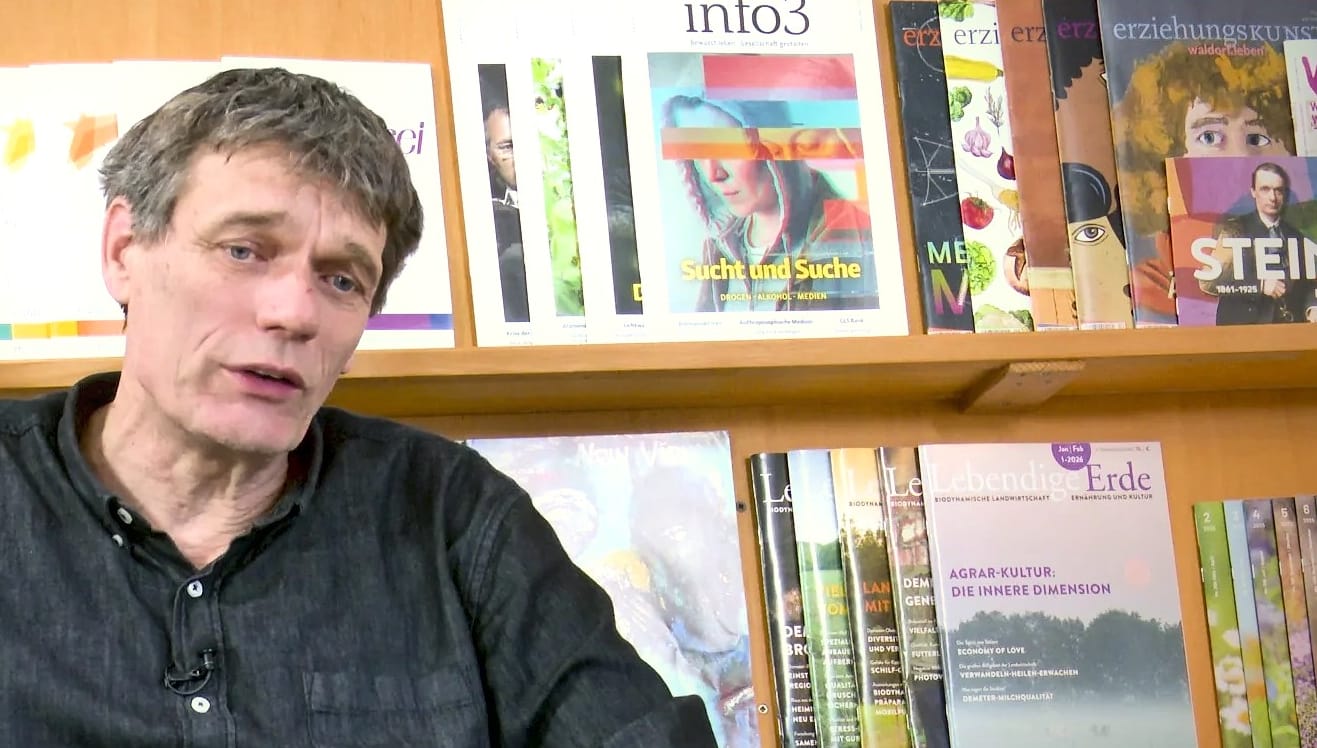
A conversation with Martin von Mackensen
How can agriculture help to build up soils, sequester carbon and secure our foundations of life in the long term? Martin von Mackensen describes how industrial development over the past 150 years has fundamentally changed crop cultivation, animal husbandry and food production – and why this system is reaching its limits today. The conversation addresses new breeding goals, gentle technology, community-run farms and the question of who agricultural land should actually belong to. Starting from his personal encounter with Joseph Beuys and his work at Dottenfelderhof, von Mackensen outlines concrete perspectives for an agriculture that connects ecological responsibility, research and social renewal.
A conversation with Martin von Mackensen, head of the Landbauschule, about Beuys, art and a deeper understanding of life and the earth
German | Subtitles · DE · EN
Publication: 2 October 2026
Translated by AI from the original (Deutsch), not reviewed · Read the original